
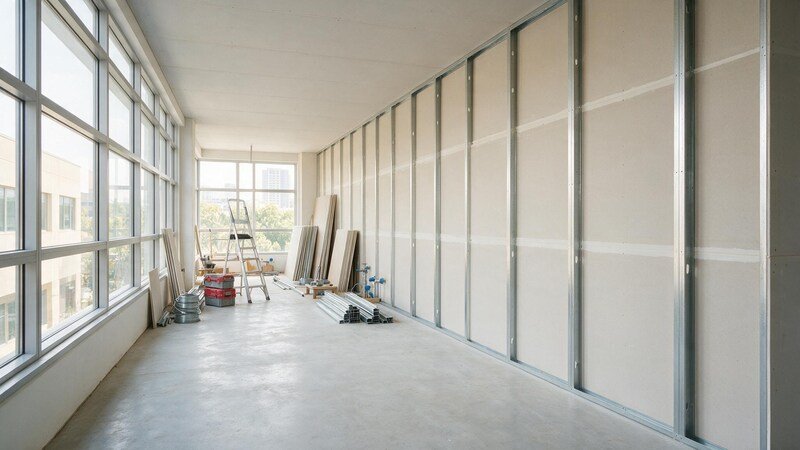
Single-Layer Partitions
Standard office and residential partitions using one layer of board each side of a metal stud frame — the fastest way to subdivide a floor plate.
Home / Applications / Partitions
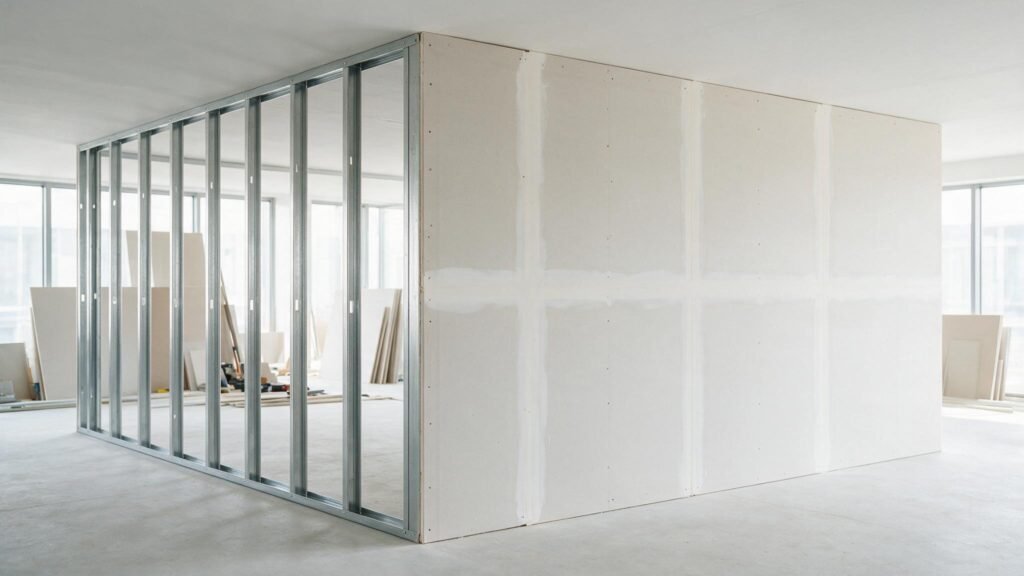
Gypsum board partitions divide space quickly and cleanly, without the weight, mess or drying time of blockwork. The finish, however, is only ever as good as the jointing behind it — a partition is judged on whether you can still see where the boards met.
Gyraffe supplies the two products that decide that outcome: Gypsum Jointing Compound for embedding tape and filling board joints, and Wall Finishing Plaster (Skim Coat) for the final paint-ready surface. Both are low-shrinkage and easy to sand, so joints stay invisible after decoration.
Request a QuoteStandard office and residential partitions using one layer of board each side of a metal stud frame — the fastest way to subdivide a floor plate.
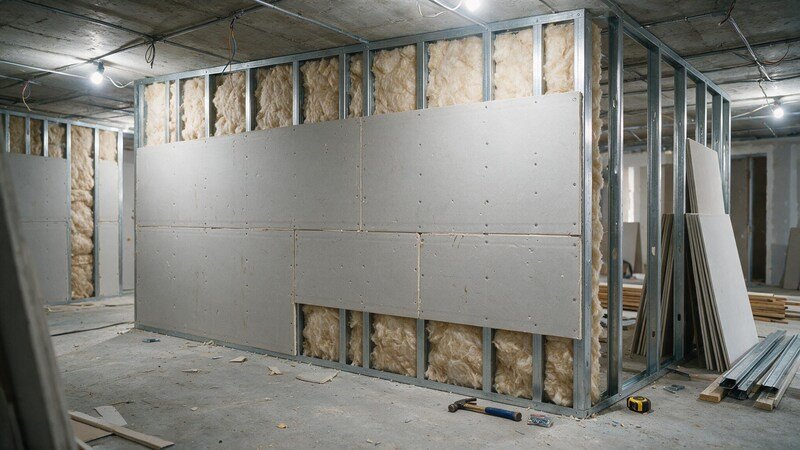
Two board layers per face with staggered joints for improved acoustic separation between rooms, suites and tenancies.
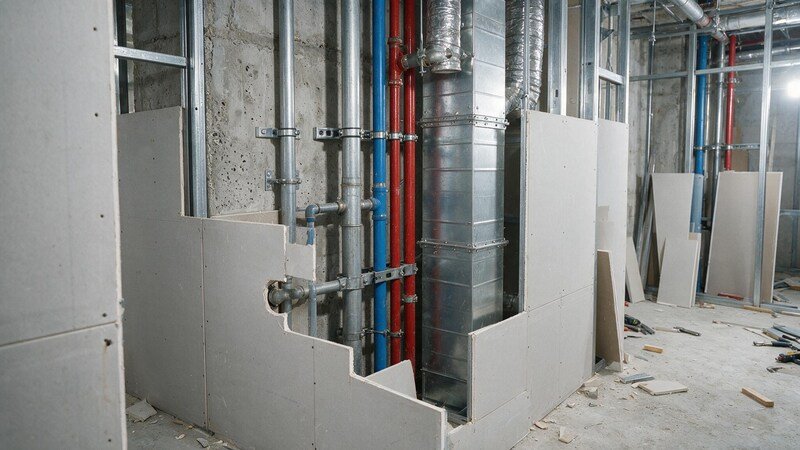
Partitions built around risers and service voids, where joints must be filled and finished to a consistent standard on the exposed face.

Formed partitions and bulkheads where boards are set to a radius — jointing compound absorbs the movement without cracking.
Partition finishing follows a fixed sequence. Each stage must be fully set before the next begins — rushing the joint coats is the single most common cause of visible seams after painting.
Mark the partition line, fix floor and ceiling tracks, then install studs at the specified centres. Check the frame is plumb before boarding — a twisted frame cannot be corrected with compound.
Verify stud centres before boarding.
Fix gypsum boards to the frame, staggering joints where a second layer is used. Leave a consistent gap at board edges for the compound to key into.
Screw heads should sit just below the surface.
Apply Gyraffe Gypsum Jointing Compound, embed the joint tape and cover screw heads. Initial set is 30 – 45 minutes and final set 60 – 90 minutes.
Mix 15 – 17.5 L of water per 25 kg bag.
Apply further compound coats at 1 – 3 mm, feathering each wider than the last. Allow each coat to set before the next.
Low shrinkage means less filling back.
Skim the boarded face with Wall Finishing Plaster at 1 – 3 mm for a uniform surface, then sand lightly once set.
Coverage approx. 18 – 22 m² per 25 kg bag at 1 mm.
Reference figures for Gyraffe Gypsum Jointing Compound and Wall Finishing Plaster, the two products used to finish a gypsum board partition. Always refer to the product datasheet for project-specific values.
Gypsum Jointing Compound embeds the tape and fills the joints at 1 – 3 mm per coat, then Wall Finishing Plaster gives the paint-ready surface.
Initial set is 30 – 45 minutes and final set 60 – 90 minutes; allow each coat to set fully.
Yes — double-layer partitions with staggered joints and insulation improve separation between rooms.